


Experience Pando
Standing inside Pando is a different thing from reading about it. The world’s largest tree is open year-round and free to visit — green and quaking in summer, gold in fall, quiet in winter. Here’s everything you need to visit at home, or in Utah, from the people who work to study and care for Pando.
Did you read a story or hear something about Pando worries you? Visit our Science Communication Center to learn more.
Friends of Pando FAQ's
Table of Contents
Recreate Responsibly
Planning to visit? Be a Good Friend of Pando!
Visiting Pando responsibly means following a few simple rules that protect both the tree and the experience for other visitors.
- Be a good gatekeeper. Be sure gates and protective fencing are securely closed behind you.
- Don’t carve into the tree. Carving promotes the spread of disease and is punishable by a fine of $500, 6 months in jail, or both. Report such activity to Fishlake National Forest at (435) 896-9233.
- Do not collect wood. Collection of wood without a permit is prohibited and carries penalties of $500 and up to 6 months in jail, or both. For wood collection permits, call the Fremont River Ranger District at (435) 836-2800.
- Don’t tamper with monitoring equipment. Pando is a living laboratory — please don’t tamper with, remove, or destroy monitoring equipment.
- Keep pets on a leash. U.S. Forest Service rules require it, protecting both your pets and the animals who call Pando home.
- Don’t feed or harass wildlife. This protects you and the wildlife.
- Don’t climb Pando. Branches break off easily and can cause injury.
- Leave the area during storms. High winds can break branches, and lightning strikes are common at this elevation.
- Be considerate of others. Some people plan and wait a long time to visit Pando.
- Don’t be a litterbug. Pando has no trash facilities — pack out what you pack in.
Sources: Friends of Pando | The Pando Tree, Visit Utah
Getting to Pando
Where is the Pando Tree?
Pando is located along Utah Highway 25 on the southwest edge of Fish Lake, in Utah’s Fishlake National Forest. Pando is about an hours drive southeast of Richfield, Utah, and northwest of Capitol reef National Park.
What's the best time of year to visit?
The best time to visit depends on what you’re after: late May through June brings Pando’s spring leaf-out, July through September is peak growing season with wildflowers and dark-sky stargazing, and mid-September into early October is fall color season — the most popular and crowded time to visit. In winter (November–April) trail access is blocked by snow and ice, but Pando is still visible from a distance with nearby Fish Lake frozen over.
Trails and roads are generally accessible May through October, shifting year-to-year with snowpack, so check current conditions before you go.
For the most up to date information about what we do, including neighborly advisories on weather, wildfires and travel hazards, join Friends of Pando on Facebook.
How do I get to Pando by car?
Pando is reachable from several major Utah and Nevada cities via well-marked highway routes into the Fishlake Scenic Byway.
From Salt Lake City: (~2.5 hrs, ~170 miles): I-15 south to Scipio, then Highway 50 to Sigurd, connecting to Highway 24 then Highway 25 into the Fishlake Scenic Byway. Map: Salt Lake City to Fish Lake
From Las Vegas (~3.5 hrs): I-15 north to Cedar City, then Highway 89 north, connecting to Highway 24 and Highway 25. Map: Las Vegas to Fish Lake
Once you’re on Highway 25 (the Fishlake Scenic Byway), watch for highway signage directing you to Pando — the tree is well marked from the road.
Sources: Fishlake National Forest Guide (USDA Forest Service) | Utah State Route 25 — Wikipedia
Is there a direct flight or bus to Pando?
No. There’s no airport or bus service that goes directly to Pando or Fish Lake — both options require a car for the final stretch. Salt Lake City International (SLC) is the main flight option, about 2.5 hours from Pando by car with the widest range of flights and rental cars; Cedar City Regional Airport (CDC) is closer as the crow flies but has far more limited commercial flights. Greyhound stops in Richfield, about 25 miles from Fish Lake, but it’s a bus-stop-only location with no onward public transit to Pando. Either way, plan on a rental car, rideshare, or prearranged ride for the last leg — searching “Friends of Pando” on Google Maps will drop you at a pin placed specifically so visitors don’t get lost.
Source: Greyhound — for schedules and stops, visit Greyhound’s website
Is hiking Pando accessible to people with live with disabilities?
Generally no. Pando hugs the slope of a steep basin wall and its floor is littered with volcanic rocks, downed trees and branches. While the trail cannot be made safe and accessible, visitors can still enjoy Pando via a car ride on Utah Highway 25, which cuts through the tree, or by entering the Dr. Creek Campground which is on Pando’s northeast arm.
As hiking Pando cannot be made consistently accessible, Friends of Pando co-founder Lance Oditt, whose family had many members who had permanent disabilities, worked to document the tree in 360 degrees, so anyone can experience and explore Pando from home using their desktop computer, mobile device or VR headset. Visit the Virtual Pando Project page to learn more.
A road runs right through Pando — didn't anyone think about that? Won't it hurt the tree?
The road through Pando isn’t new and isn’t a threat — it’s actually much older than most people expect. What’s now paved as State Route 25, part of the Fishlake Scenic Byway, follows a route dating back to the 1700s as part of the Old Spanish Trail. The modern road was added to Utah’s state highway system in 1918 and modernized in 1935, decades before Pando was even documented in 1976. A two-lane paved road running through part of a 106-acre root system simply isn’t the kind of disturbance that threatens a tree this large and resilient — Pando has grown and thrived alongside it the whole time.
Sources: Utah State Route 25 — Wikipedia | Fishlake Scenic Byway | What is the Pando Tree?
Once You Arrive
Where do I park?
Park at the Old Spanish Trailhead, right off Highway 25, where the Lakeshore National Recreation Trail takes you onto a spur trail through Pando.
NOTE: New highway and trail signage for Pando is being installed through Summer of 2026. Visit Twin Creeks Information booth for help if you get lost.
Is there an entry fee or do I need a reservation?
No entry fee and no reservation required — Pando sits on Fishlake National Forest land, which like most national forests doesn’t charge for general access. The road never closes, but seasonal conditions like snow and ice can affect driving, so check current road conditions before heading up, especially in winter.
Sources: The Pando Tree | Visit Utah | Fish Lake Recreation Area — U.S. Forest Service
Where can I get Pando information?
Friends of Pando offers a free informational brochure you can download.You will find printed versions available at entry points and visitor gates throughout Pando and the Fish Lake Basin.
Our brochure, which is updated yearly, features the story of Pando, offers a plethora of unique facts and figures from our website and details ongoing work to care for this ancient Utah wonder.
Is there a map, do I need to get one?
Yes, we offer a basic landmass map for download, but you won’t need a trail map as Pando only has one “out and back” trail marked for visitors.
Is their a Pando exhibit or visitor center?
Not today, but one is planned for installation on the edge of Pando in the coming year.
In the meantime, there are plenty of folks who can help.
Within Fish Lake Basin:
The US Forest Service’s Twin Creek Information Booth (Just past Fish Lake Lodge on Utah Highway 25) has information about Pando.
On your way to Pando
Richfield Visitor Center has an educational exhibit dedicated to Pando and staff knowledgeable about the tree. You can touch a tree, hear how Pando sounds and learn what makes Pando unique when you visit.
Richfield Visitor Center Details
Address: 1075 North Main Street Richfield, Utah, 84701.
Richfield Visitor Center Hours:
April 1 through Memorial Day from 10 a.m. to 4 p.m.
Memorial Day through Labor Day from 9 a.m. to 5 p.m.
OPEN ALL MAJOR HOLIDAYS!
Sources: The Pando Tree | Visit Utah | Fish Lake Recreation Area — U.S. Forest Service
What's with these fences, am I allowed in?

Yes, you can enter through multiple gates. The”fences” you see from your car are not fences at all, but wildlife controls used to move deer and elk around the tree as they can eat at Pando faster than it can recuperate. These wildlife controls have been used dating back to the 1990’s and are monitored and maintained by Friends of Pando and our agency partners to protect Pando and restore predator-prey dynamics in and around the tree.
Is there a trail? How long or difficult is it?
Yes — a 1.4-mile out-and-back trail runs from the Old Spanish Trailhead to Coot’s Slough. The trail takes about 1-1.5 hours round trip. The trail is mostly flat and sits at around 8,900 feet of elevation.
The trail would be rated “easy” but we warn those who are not used to elevation or have heart or respiratory issues, that they may find themselves out of breath, so pace yourself. We also strongly recommend hikers wear closed- toed shoes as Pando is full of sharp rock and debris. Lastly, for the safety of animals who call Pando home and, hikers alike, we do not advise you hike at dusk or dawn as that when predators are most active.
Sources: The Pando Tree | Visit Utah
Are bikes are motortized vehicles allowed in Pando?
No. Bikes, e-Bikes and motorized vehicles are not allowed in Pando and will not pass through visitor gates.
Are there guided tours of Pando?
Friends of Pando does not offer a guided-tour program, but we offer other ways to experience the tree with more depth than a self-guided visit.
- Friends of Pando hosts virtual and in-person workshops for groups, and provides educators with free resources to teach about Pando.
- Friends of Pando offers free Virtual Tours you can enjoy from your home using any desktop, mobile device or VR headset.
- For a more hands-on connection, we welcome you to volunteer to help with restoration, protection, and beautification work each summer alongside Friends of Pando, neighbors, and agency partners — a way to experience Pando firsthand while directly contributing to its care.
Independent commercial tour operators *may* offer guided visits to the area or, to Pando itself. As a nonprofit organization, Friends of Pando cannot endorse or promote specific commercial tour operators or providers.
Source: What You Can Do: 10 Ways to Help
Is there a place I can see all of Pando at once?
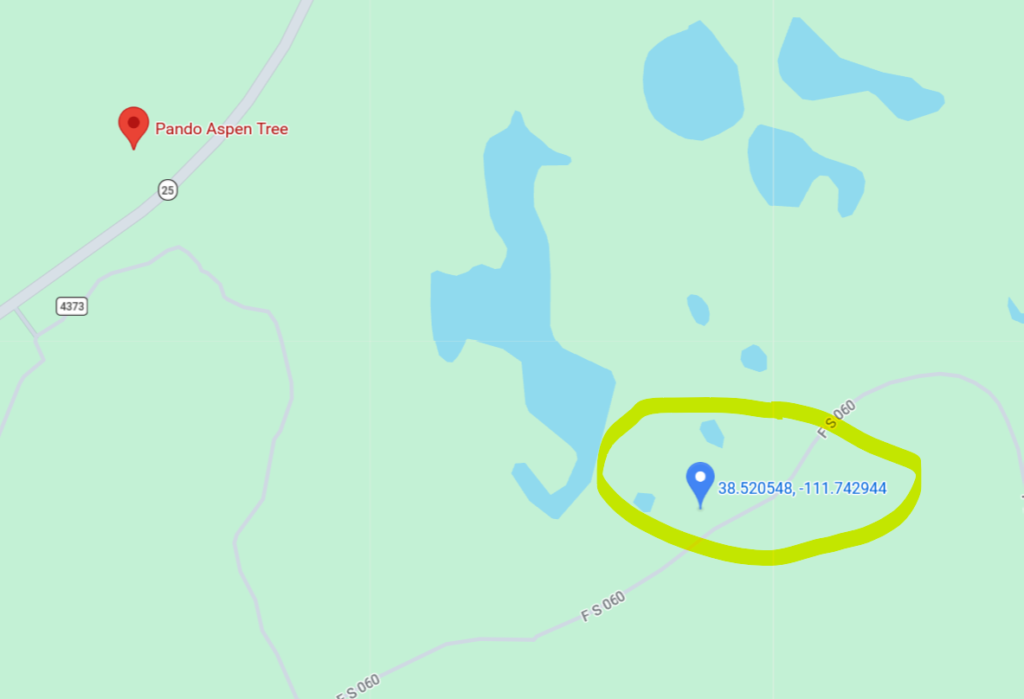
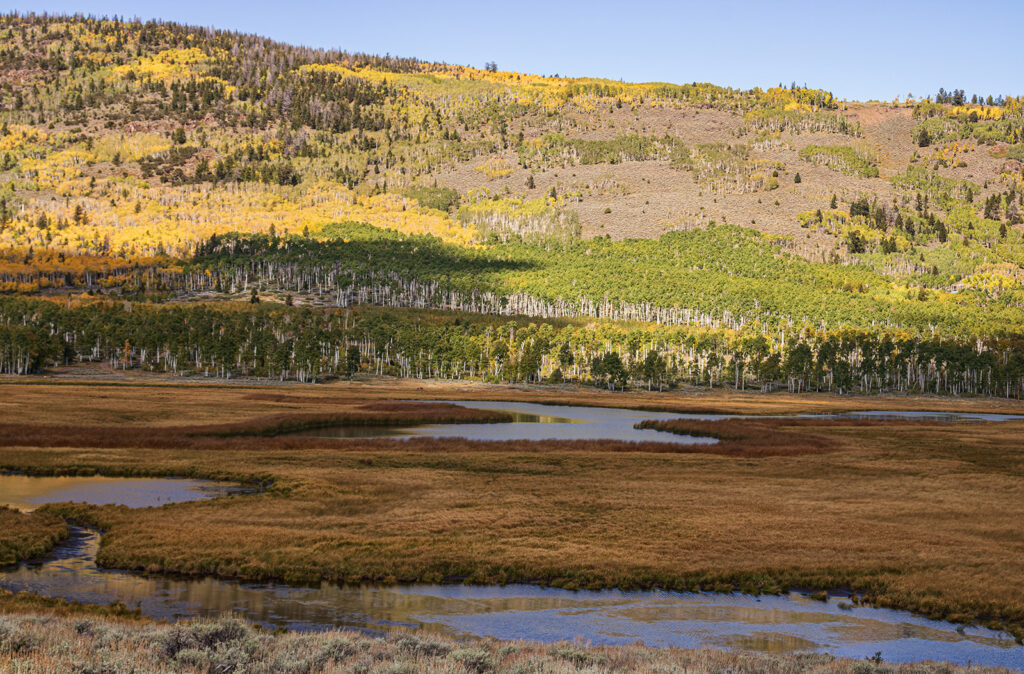
Yes. If you stand outside Pando it on the east side of Coots Slough you can see Pando’s outline twice a year.
In spring, Pando’s physical outline is visible when the trees around it get their leaves before Pando does, leaving Pando’s landmass to stand out as it has no leaves yet.
Each Fall, you see Pando’s outline again as it is so large, it keeps its leaves green longer than surrounding trees which allows you to see it as green oceans of aspen against the colored backdrop of other trees.
Do people have a "favorite" part of Pando, or is that a weird thing to ask?
Not weird at all — people connect with favorite spots in Pando the same way they would with any place they spend real time in. The Pando Photographic Survey documented around 8,500 distinct locations, and crews who walked every section over the years gave many nicknames along the way — one particularly dense, thorny stretch earned the name “Mordor.” People also connect through senses beyond sight: the sound of wind moving through thousands of shared leaves, bark texture that shifts from smooth and young to deeply furrowed with age.
Artists from the Friends of Pando Artist-in-Residence program often develop their own favorite way of experiencing the tree — sculptor Emily Loughlin, for instance, was inspired to explore how Pando’s growth patterns might look above and below ground.
Sources: St. George News — Pando Photographic Survey | Emily Loughlin Artist in Residence
What do the people who've studied and worked with Pando feel about it personally?
People who’ve spent real time with Pando keep returning to the same themes: curiosity, resilience, wonder, deep time, and a quiet sense of duty. Sound artist Jeff Rice, who spent a season recording Pando’s leaves, wind, and underground vibration, has said the tree forces fundamental questions on us — a single organism defying our sense of individuality, a vastness that humbles our sense of space. Composer Nancy Ives called the existence of a 9,000-plus-year-old organism “awe-inspiring,” while land artists Harriet and Rob Fraser said thinking about Pando’s size and longevity shifted them into “a state of enchantment, wonder, and curiosity.” What ties these voices together isn’t agreement on facts or figures — it’s a shared sense that spending real time with Pando changes how you see it.
Sources: Jeff Rice, Pando Suite artist statement | Science Friday — Listen to Pando, the Largest Tree (2023) | Nancy Ives Artist in Residence | Harriet & Rob Fraser Artist in Residence
If I hug one trunk of Pando, is that the same as hugging all of Pando?
Yes. Each trunk is genetically identical to the Pando seed that set down thousands of years ago and, each trunk around you.
Be careful though, and don’t hug a trunk if you are wearing anything sharp or metallic as Pando’s bark is thin and scratches and tears easily which can allow diseases to settle in.
If I visit Pando, would I be able to see the part that is 9,000 years old?
No — each stem of Pando typically lives 100–150 years, so no individual stem visible today comes close to the clone’s true age. The original 1976 study found mature stems averaging 100–105 years old, while more recent USDA Forest Service guidance puts current stem ages at 120–150 years. The root system is constantly spreading and extending outward, so it’s unlikely any part of the “original” root system remains to test today — but every part of Pando is from the seed that took root thousands of years ago.
Sources: Kemperman & Barnes 1976, Canadian Journal of Botany 54(22) | Kitchen et al. 2019, RMRS-GTR-390, USDA Forest Service
Overnight In Dark Sky Country
Where can I stay overnight near Pando?
Lodging options near Pando range from lakeside resorts a few minutes away to small-town inns 30–50 minutes out, depending on how close you want to stay.
- Fish Lake (closest, ~5–10 min from Pando): Fish Lake Lodge, Lakeside Resort Cabins, and Bowery Haven Resort.
- Loa (~25 min to the east): The Snuggle Inn and Road Creek Inn, plus widely available Air BnB rentals and RV parks throughout Loa and Wayne County.
- Torrey (~50 min to the east): The Rim Rock Inn (nicer) or Austin’s Chuckwagon Motel (value).
- Richfield (~45 min to the northwest). The fullest range of amenities: Chain hotels including Comfort Inn, Fairfield Inn & Suites, Hampton Inn, Holiday Inn Express, and Best Western, most clustered near I-70.
Sources: Richfield, Utah — Places to Stay | Capitol Reef National Park — Places to Stay (Utah.com)
Can I camp in Pando or nearby?
Yes — several developed Forest Service campgrounds ring Fish Lake, including Doctor Creek, Mackinaw, and Bowery Creek, filling up fast on summer weekends, so reserve ahead through Recreation.gov where available.
Dispersed camping isn’t allowed in Pando or the Fish Lake Basin itself, though it’s broadly permitted elsewhere in Fishlake National Forest.
Sources: The Pando Tree | Visit Utah | Fishlake National Forest Guide (USDA Forest Service)
Enjoying Pando's Homeland
Things to Do in the Area
Beyond Pando itself, the Fish Lake Basin and surrounding towns offer boating, hot springs, hiking, and dark-sky stargazing within easy driving distance.
Some regular and annual events you might enjoy in the area
- Fish Lake — boating, fishing, kayaking
- Fishlake Scenic Byway — scenic drive through the basin
- Zedds Meadow — a beautiful meadow along the Fremont River
- Red Hill Hot Springs (Monroe, free) or Mystic Hot Springs (Monroe, reservation-only)
- Richfield Visitor Center — the Pando Gateway exhibit, plus maps and brochures fro all the areas wonders
- Glenwood Hills — badlands terrain in the Painted Hills clay formation, popular for OHV riding, mountain biking, and geocaching
- Fremont Indian State Park — petroglyphs and pictographs from the largest known Fremont culture village site
- Capitol Reef National Park — red-rock hiking, about 1 hour east via Utah Highway 24
- Paiute ATV Trail — 275 miles of trail through the region (note: no ATVs or e-bikes within Pando itself)
- In Torrey: browse local art at Gallery 24, and catch a Saturday-night talk or concert at the Entrada Institute’s lecture series at Robber’s Roost
- In Loa: grab a pizza at the Snuggle Inn’s bistro
- Big Rock Candy Mountain (Sevier Canyon, about 45 min from Richfield): its namesake caramel-colored volcanic formation, river rafting, and the Candy Mountain Express bike trail
- Birdwatching at Coot Slough — the marshy wetland at the end of the Old Spanish Trailhead trail — Audubon’s guide to birding in Utah Utah bird checklists by county
- Hike the Lakeshore National Recreation Trail — a 17-mile trail circling Fish Lake in four sections
- Stargazing — Pando sits in a dark sky county — What’s visible tonight Dark Sky Calendar — best stargazing dates · Heritage StarFest — annual telescope festival, Entrada Institute & NPS
- Sunglow Canyon — a scenic red-rock box canyon near Bicknell with a short hike and campground, a good sunset stop toward Capitol Reef
- Butch Cassidy’s Boyhood Home — a free roadside stop near Circleville, about 1 hour south of Richfield
- County fairs: Wayne County Fair (Loa, August 10-15, 2026); Piute and Sevier County Fairs (late July-early August, 2026 dates to be confirmed)
- Red Rocks Fall Fly-In — annual paragliding gathering at the Monroe Rodeo Ground, held late September
- Eyes to the Sky Balloon Festival — hot air balloon launches at sunrise in Salina, typically mid-to-late June
Sources: Fishlake National Forest Guide (USDA Forest Service) | Red Hill (Monroe) Hot Springs — RoadTripRyan | Big Rock Candy Mountain Resort | gjhikes.com — Butch Cassidy Boyhood Home | 2026 Wayne County Fair — NowPlayingUtah | CUASA — Monroe Peak paragliding | Coupons4Utah — Utah Hot Air Balloon Festivals | Gallery 24 — Art of Torrey, Utah | Entrada Institute | BLM — Glenwood Open OHV Area | Fishlake National Forest — Sunglow Campground | Visit Utah — Guide to Fish Lake | The Pando Tree | Visit Utah | Audubon’s guide to birding in Utah | Dark Sky Calendar | Heritage StarFest
Friends of Pando FAQ Collection
Answers from the people who work to care for Pando every day
Friends of Pando is dedicated and working to educate the public, support research and preservation efforts and inspire stewardship of Pando, the world’s largest tree.
Friends of Pando is a proud partner of Pando’s public land stewards, Fishlake National Forest of the U.S. Forest Service, Department of Agriculture. Learn more about our partnership.
Friends of Pando and its partners are equal opportunity employers.

Just $18 a month supports work to ensure Pando can be enjoyed for generations to come. Make a one-time or, recurring tax deductible donation today.
Friends of Pando
PO Box 12
Richfield, UT, 84701
Phone: 435-633-1893
IRS EIN: 87-3958681


